
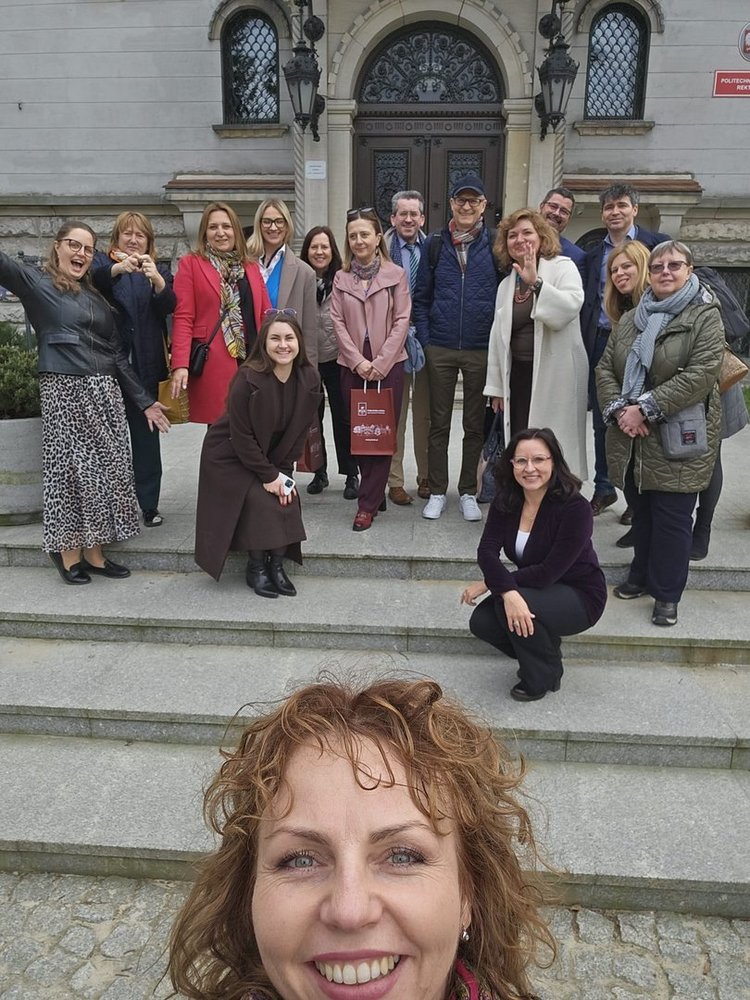
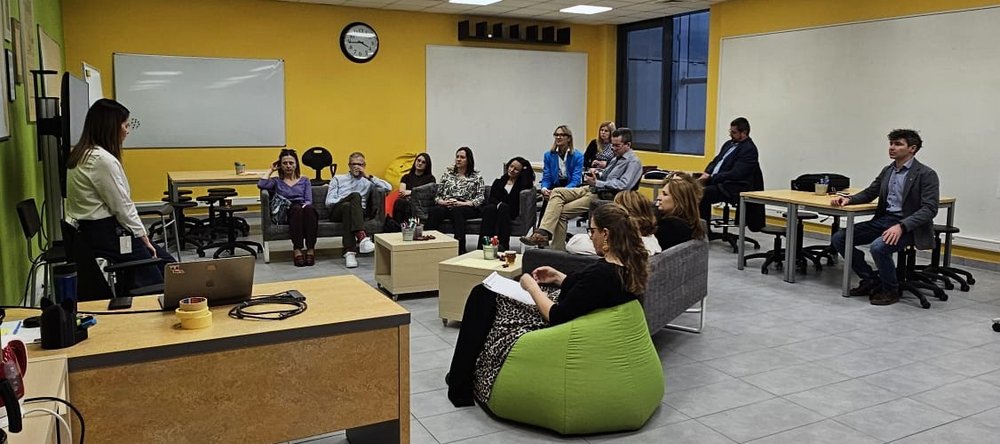
The first part of the meeting, which was held on 14 April of the current year at the Lodz University of Technology, was devoted to ways of operating and organising BUP activities at Polish higher education institutions. It was observed that in recent years the role and involvement of university international cooperation units (International Relations Office – IRO / International Cooperation Office – ICO) in coordinating BUP activities at universities has increased significantly, which was reflected in the strong representation of these units at the meeting.
A detailed discussion focused on practices related to reporting activities undertaken by academic communities to achieve the seventeen Sustainable Development Goals (SDGs) set out in the 2030 Agenda for Sustainable Development, adopted by the United Nations in 2015. In this context, organisational solutions implemented at universities and universities of technology in the areas of social and environmental responsibility of higher education institutions and ESG reporting were also discussed. As an example of good practice related to university climate policy, the methodology for calculating the so-called carbon footprint was presented.
The second part of the Łódź meeting was devoted to action plans for 2026 and the following years, as well as to developing proposals for future actions and initiatives by Polish universities belonging to the BUP network. Meeting participants took part, among other things, in workshops conducted using the Design Thinking method, within which key challenges related to BUP activities were identified. These include:
- the need to develop a new BUP agenda,
- undertaking actions to increase the attractiveness of BUP initiatives in relation to competing offers from other academic networks,
- improving internal and external communication – the visibility and recognisability of the network nationally and across Europe.
Dr hab. Dominik Drzazga:
Analysing BUP activities on the one hand from the perspective of the network’s 35 years of experience, and on the other in the context of contemporary development challenges such as deepening anthropogenic climate change and other forms of human pressure on the environment, global geopolitical tensions and the conflicts accompanying them, as well as changes in communication and education methods resulting from the rapid acceleration of digital tool development and the computerisation of life – it was recognised during the meeting that traditionally used educational initiatives are no longer sufficient to achieve BUP’s existing core objectives (i.e. supporting community development in line with the sustainability paradigm and with respect for the principles of democracy and peaceful cooperation).
An assessment of the effectiveness of initiatives undertaken to raise public awareness and disseminate good practices in sustainable development shows that information and knowledge, although they played an important role in the transformation of the Baltic Sea Region after 1990, are not sufficient motivating factors for engaging communities and their institutions or for strengthening cross-sectoral and international cooperation in this field. In this context, bearing in mind the aforementioned need for discussion on a new BUP agenda and recognising the potentially significant role of universities in building partnerships for sustainable development, the idea was considered and an initial willingness was expressed to organise an international conference in Łódź in 2027, addressed in particular to academic communities from BUP universities, under the working title “Re-thinking sustainability.”
Independently of the above-mentioned conference, it is planned to organise a remote scientific event (webinar / conference) at the University of Lodz in 2026, as part of a series of initiatives undertaken to mark the 35th anniversary of BUP activities (the date and thematic scope are currently being determined).
The activities of The Baltic University Programme, initiated in 1991, are focused on education, research and cooperation in the field of sustainable development. The aim of BUP is to support the development of strong regional educational and research institutions, as well as to organise events integrating communities of students, doctoral students and academic teachers. The BUP network currently comprises over 110 higher education institutions (including 34 from Poland) and strengthens the key role of universities in the democratic, peaceful and sustainable development of the Baltic Sea Region. The University of Lodz joined the BUP network in the mid-1990s.
Source: dr hab. Dominik Drzazga, Faculty of Management, University of Lodz
Edit: Press Office, University of Lodz